Renders a point grid as ridgeline polygons (Joy Division style). Each slice along one axis becomes a filled polygon, creating a cross-sectional view of the surface.
Usage
geom_ridgeline_3d(
  mapping = NULL,
  data = NULL,
  stat = "identity_3d",
  position = "identity",
  ...,
  direction = "x",
  base = NULL,
  cull_backfaces = FALSE,
  sort_method = "pairwise",
  scale_depth = TRUE,
  force_convex = FALSE,
  light = NULL,
  na.rm = FALSE,
  show.legend = NA,
  inherit.aes = TRUE
)
Arguments
- mapping
Set of aesthetic mappings created by
aes().- data
Point grid data with x, y, z coordinates.
- stat
Statistical transformation. Defaults to "identity".
- position
Position adjustment, defaults to "identity".
- ...
Other arguments passed to the layer.
- direction
Direction of ridges:
- "x"
One ridge per unique x value; ridge varies in y (default)
- "y"
One ridge per unique y value; ridge varies in x
- base
Z-value for ridge polygon bottoms. If NULL, uses min(z).
- cull_backfaces
Logical indicating whether to remove back-facing polygons from rendering. This is primarily for performance optimization but may be useful for aesthetic reasons in some situations. Backfaces are determined using screen-space winding order after 3D transformation. Defaults vary by geometry type: FALSE for open surface-type geometries, TRUE for solid objects (hulls, voxels, etc. where backfaces are generally hidden unless frontfaces are transparent or explicitly disabled).
- sort_method
Depth sorting algorithm. See sorting_methods for details.
- scale_depth
Controls whether polygon linewidths are scaled to make closer lines wider and farther lines narrower, based on the mean depth of a polygon.
TRUE(the default) applies full scaling andFALSEdisables it; a number sets the strength directly, where1matchesTRUE,0matchesFALSE, values below 1 subdue the effect and values above 1 exaggerate it. This affects the layer only; usecoord_3d(scale_depth = )for gridlines, cube borders, axis ticks, and axis text.- force_convex
Logical indicating whether to remove polygon vertices that are not part of the convex hull. Default value varies by geom. Specifying TRUE can help reduce artifacts in surfaces that have polygon tiles that wrap over a visible horizon. For prism-type geoms like columns and voxels, FALSE is safe because polygons fill always be convex.
- light
A lighting specification object created by
light(),light("none")or the string"none"to disable lighting, orNULLto inherit plot-level lighting. Set plot-level lighting by addinglight()to the plot, and layer-specific lighting via thelightargument ofgeom_*_3d()functions, which takes precedence.- na.rm
If
FALSE, missing values are removed.- show.legend
Logical indicating whether this layer should be included in legends.
- inherit.aes
If
FALSE, overrides the default aesthetics.
Aesthetics
- x, y, z
Point coordinates (required)
- fill
Polygon fill color (default: "grey70")
- colour
Polygon border color (default: "black")
- alpha
Transparency
- linewidth
Border width
- linetype
Border type
Examples
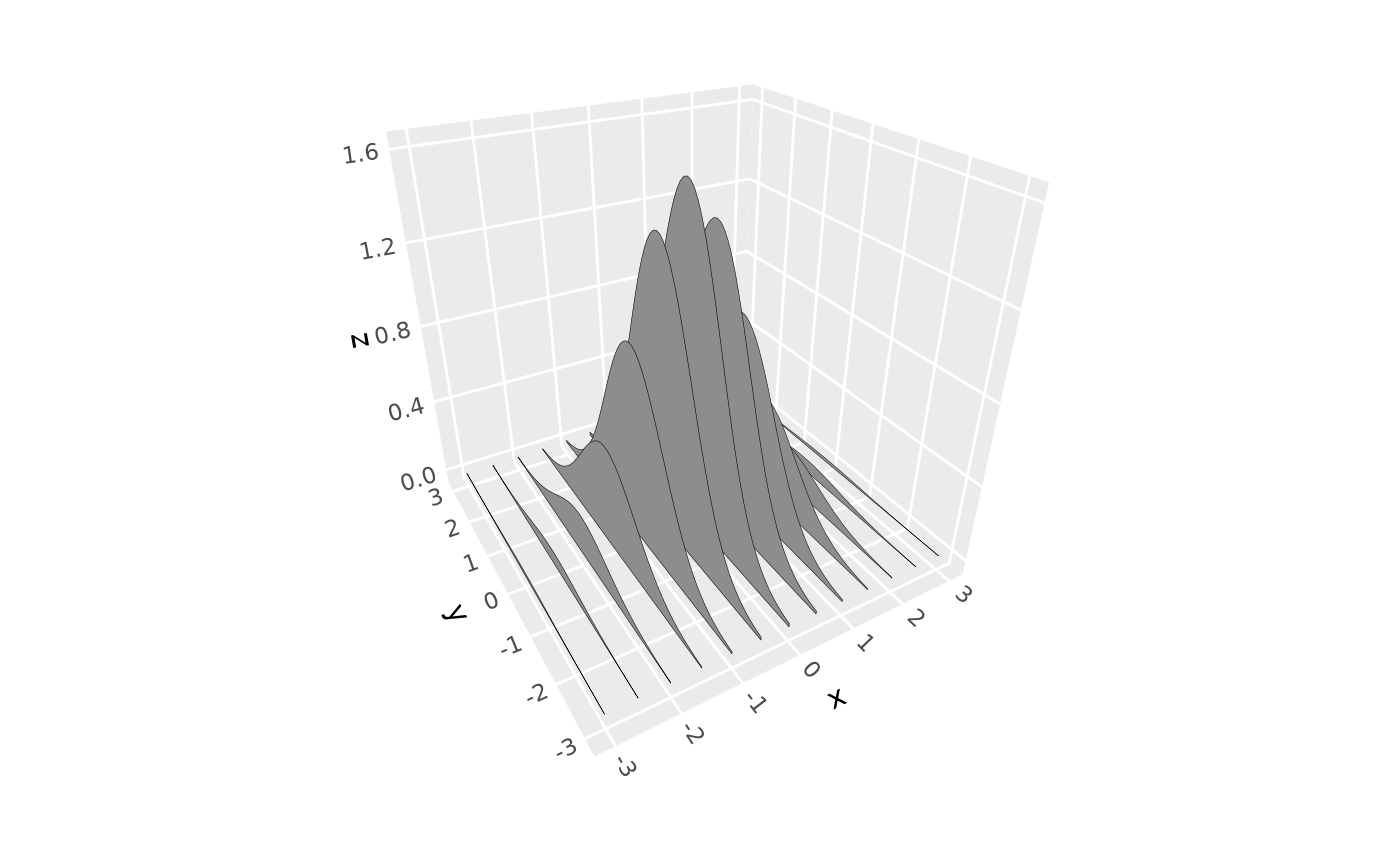
# From point grid
grid_data <- expand.grid(x = seq(-3, 3, 0.5), y = seq(-3, 3, 0.1))
grid_data$z <- with(grid_data, dnorm(y) * dnorm(x) * 10)
ggplot(grid_data, aes(x, y, z = z)) +
geom_ridgeline_3d() +
coord_3d()
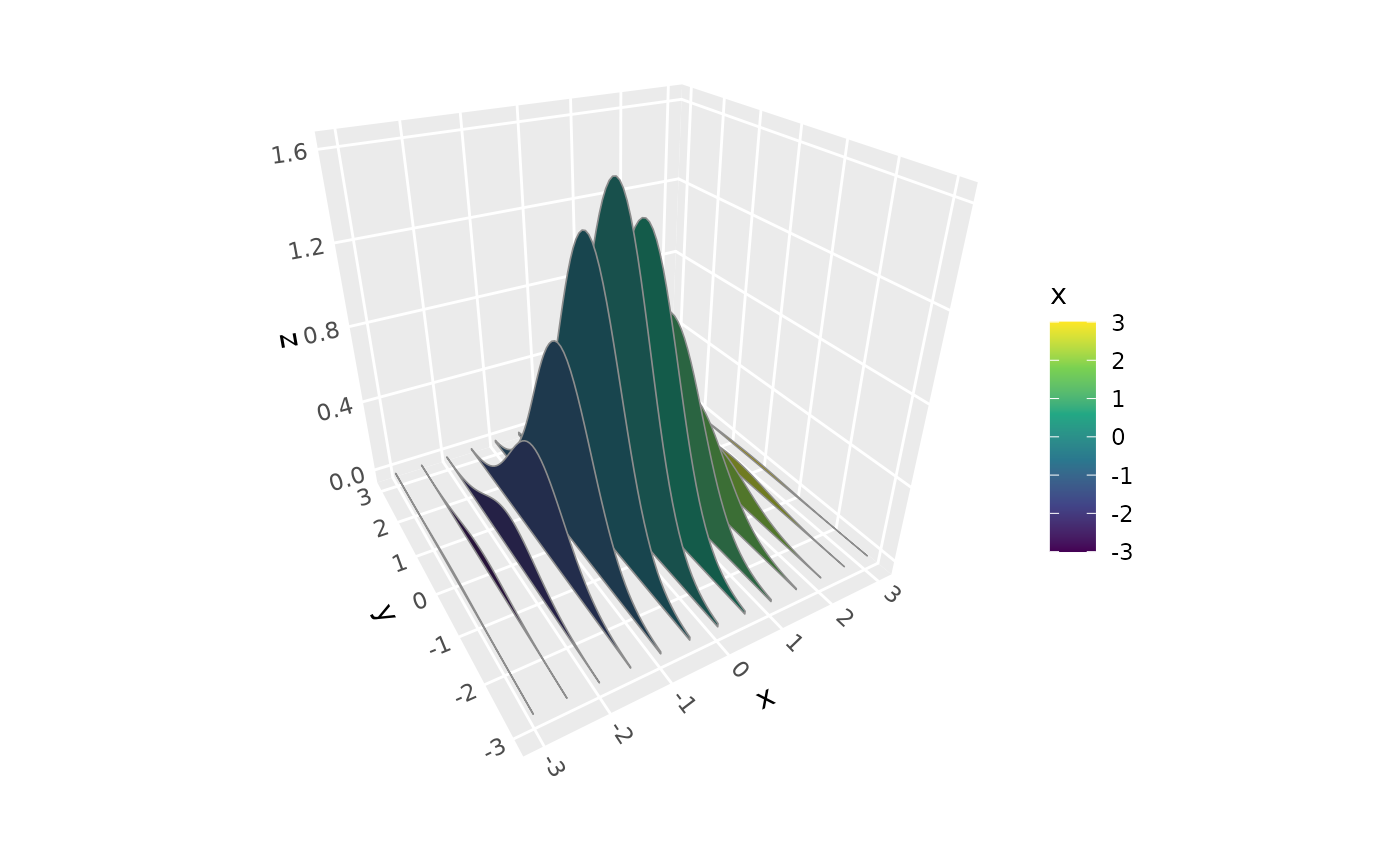
 # With fill
ggplot(grid_data, aes(x, y, z = z, fill = x)) +
geom_ridgeline_3d(colour = "white", linewidth = 0.3) +
scale_fill_viridis_c() +
coord_3d()
# With fill
ggplot(grid_data, aes(x, y, z = z, fill = x)) +
geom_ridgeline_3d(colour = "white", linewidth = 0.3) +
scale_fill_viridis_c() +
coord_3d()
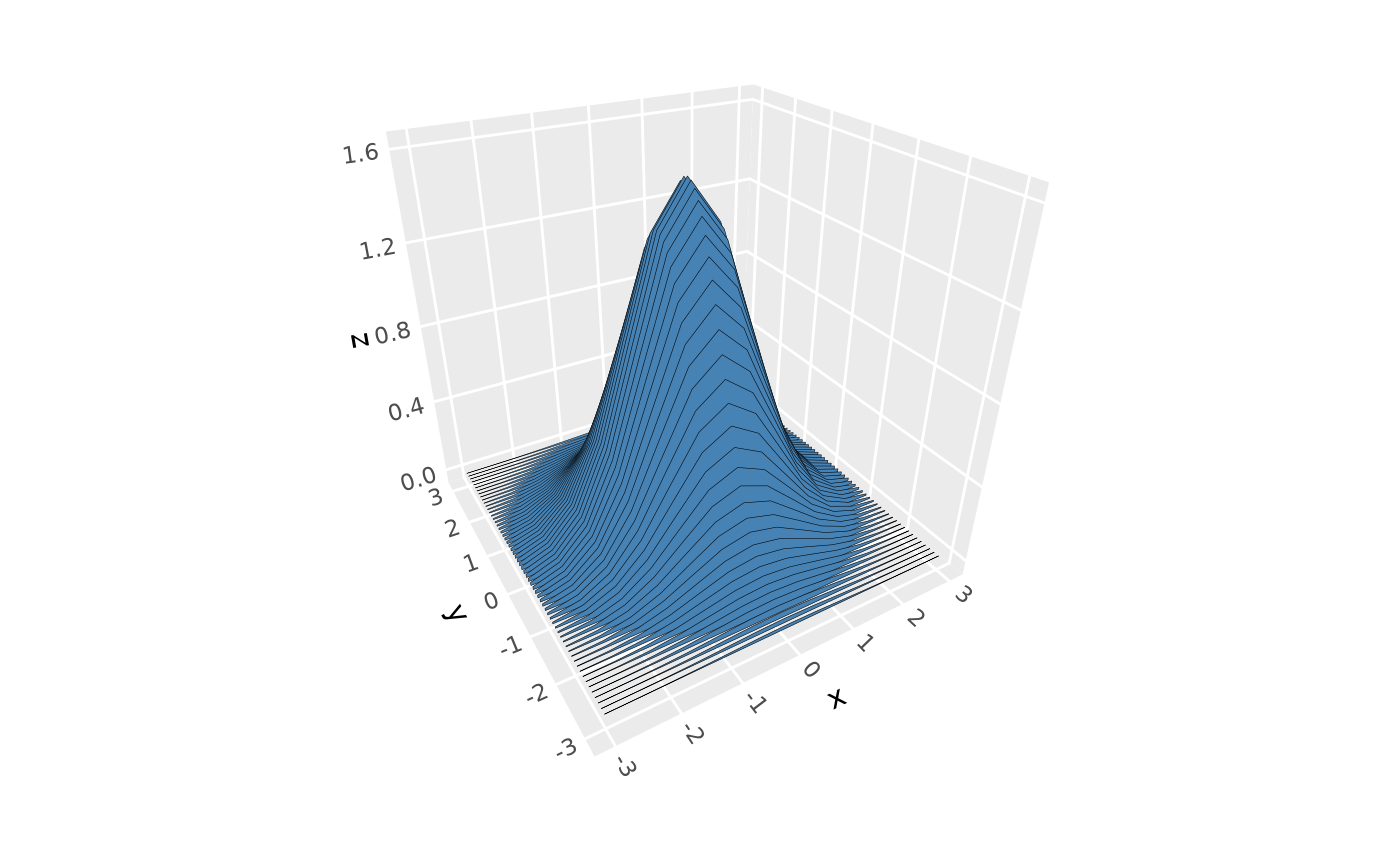
 # Ridges in y direction
ggplot(grid_data, aes(x, y, z = z)) +
geom_ridgeline_3d(direction = "y", fill = "steelblue") +
coord_3d()
# Ridges in y direction
ggplot(grid_data, aes(x, y, z = z)) +
geom_ridgeline_3d(direction = "y", fill = "steelblue") +
coord_3d()
 # With stat_function_3d
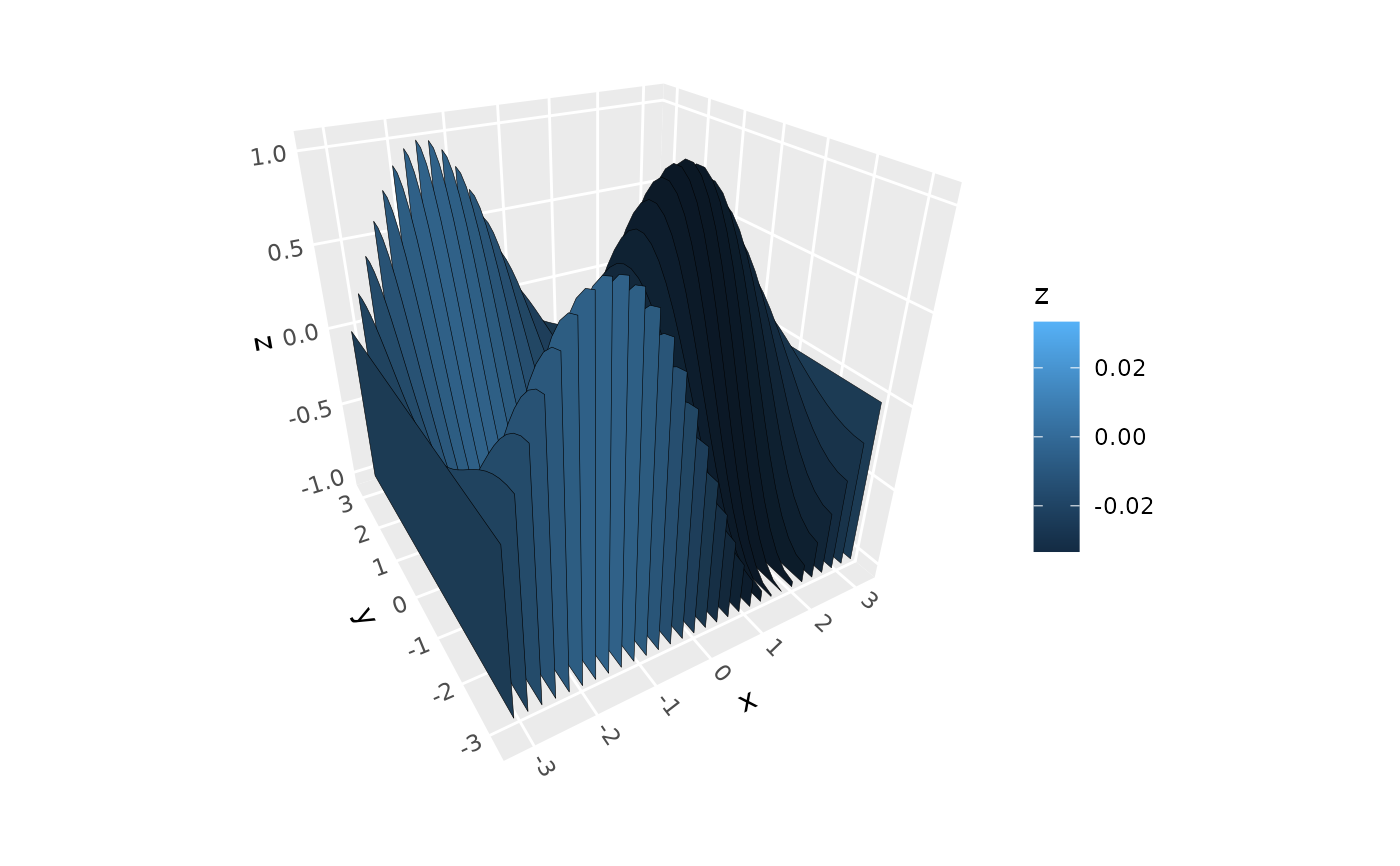
ggplot() +
stat_function_3d(fun = function(x, y) sin(x) * cos(y),
xlim = c(-pi, pi), ylim = c(-pi, pi),
n = 30,
geom = "ridgeline_3d") +
coord_3d()
# With stat_function_3d
ggplot() +
stat_function_3d(fun = function(x, y) sin(x) * cos(y),
xlim = c(-pi, pi), ylim = c(-pi, pi),
n = 30,
geom = "ridgeline_3d") +
coord_3d()