BRYOPHYTE BIOEGOGRAPHY
[PUBLICATION] Spatial phylogenetics with continuous data: an application to California bryophytes
Overview
This spatial phylogenetics project, co-led by Ixchel González-Ramírez, was a fun collaboration combining new empirical analyses with some novel methodological exploration. The paper assesses spatial patterns in the evolutionary diversity of California mosses and liverworts. It also showcases a range of recently-developed methods for making full use of continuous statistical data in spatial phylogenetic analyses.
Highlights
On the bryophyte biodiversity front, the analysis provides one of the most complete portraits of moss and liverwort diversity across California:
- Maps of bryophyte biodiversity patterns across California, including estimates of alpha diversity, biogeographic regions, and conservation priorities.
- A California bryophyte phylogeny based on new sequencing work done for this project.
- New species distribution models for 746 species of bryophytes across California.
And on the methodological front, the project demonstrates approaches for preserving the full information content of continuous SDM output, including:
- Probability-based phylogenetic diversity measure, via the phylospatial R package
- Quantitative null model algorithms, via the nullcat
- An approach called “SNAPE” (for smooth neo- and paleo-endemism) that extends CANAPE to quantitative data
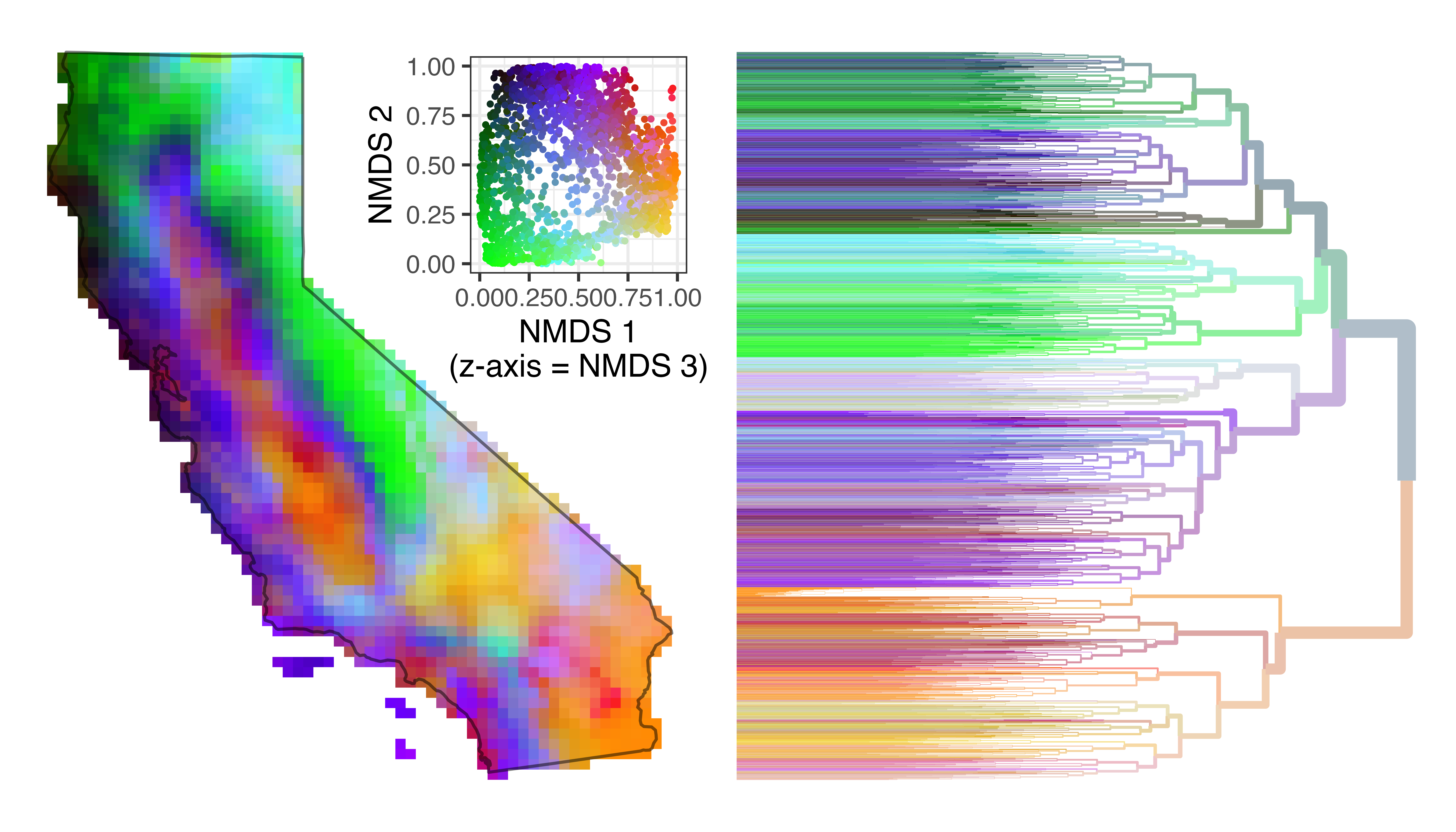
- Ordination-based dimension reduction to map spatial phylogenetic turnover gradients without discretization
Citation: M. Kling, I. Gónzalez-Ramírez, B. Carter, I. Borokini, B. Mishler. (2025) Spatial Phylogenetics with continuous Data: an application to California bryophytes. Systematic Botany 51(1): 101-120 [web, pdf]