FOREST DEMOGRAPHIC CHANGE
[PUBLICATION] Forest densification and pollution rival climate in driving U.S. tree demographic change
Overview
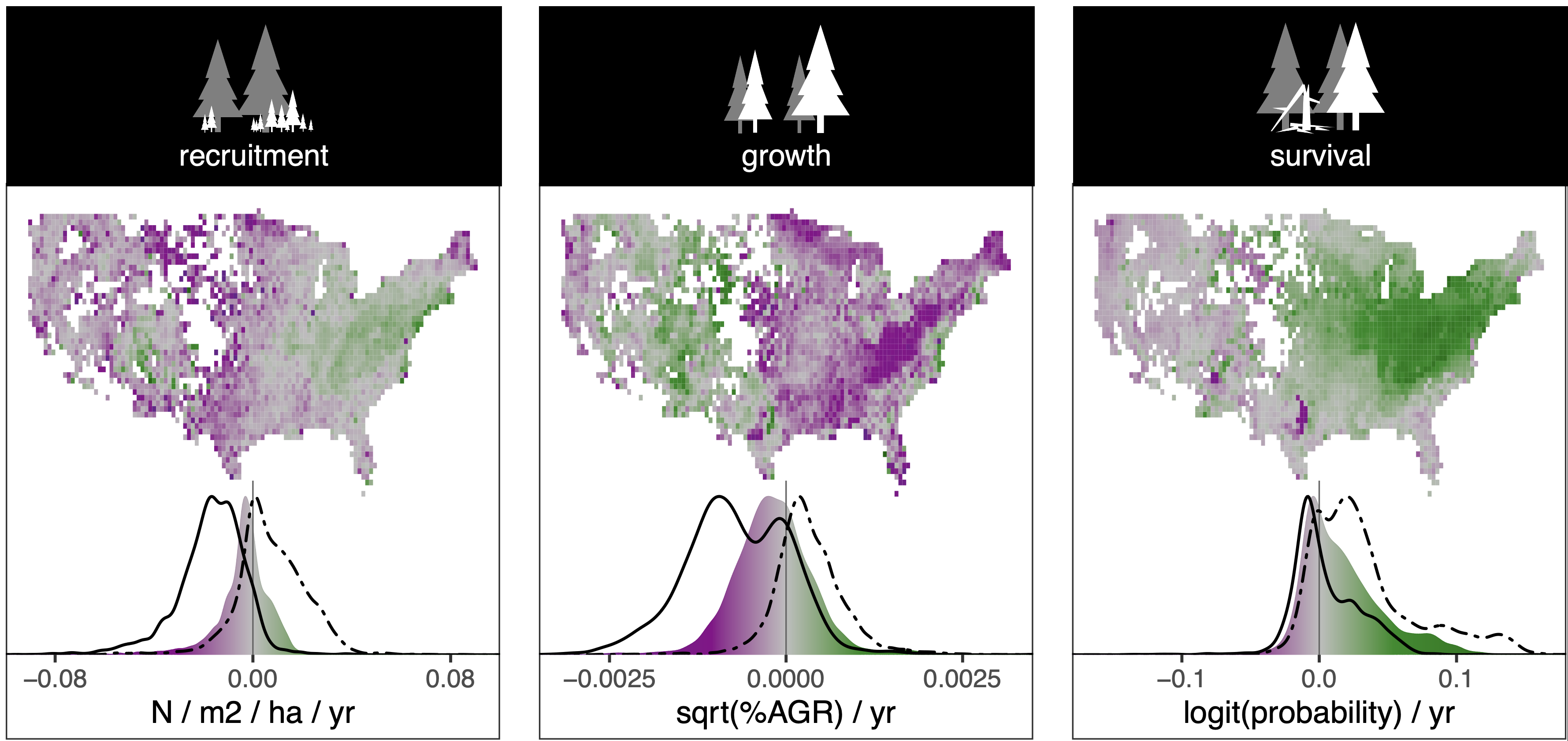
Forests are changing on many fronts, but studies usually consider the drivers of these changes, and the vital rates they impact, one at a time. In this paper in GCB, our goal was to put the major drivers on a common footing and assess their influence on the full suite of forest demographic rates. Using two decades of Forest Inventory and Analysis data, we asked how recruitment, growth, and mortality of the 100 most common US tree species respond to six environmental variables spanning climate, pollutant deposition, and forest density. The analysis uses an exposure-sensitivity framework—we estimate each species' sensitivity to each driver from spatial gradients, quantify how much each driver has actually changed at each plot, and multiply the two to get a predicted demographic trend. Then we evaluate these model predictions against observed demographic trends.
The headline result is that climate change is not yet the leading driver of forest trends in the US, which are still driven mainly by the legacy effects of recovery from historical pollution and land use patterns. (This is likely to change in future decades though, as climate change continues unabated while these other drivers decelerate.) Climate deservedly gets a lot of attention in the global change literature, but we need to be thinking about these other key drivers as well.
Highlights
- Sulfur is still the big signal. Standardized exposure to sulfur deposition change was more than three times that of the next fastest-moving variable, and sensitivity to sulfur explained the most variation in predicted trends for every demographic rate.
- Density-dependence, decomposed. Separating conspecific from heterospecific basal area shows the two act through different channels for recruitment: heterospecific density mainly affects the probability of recruitment, conspecific density mainly the recruitment rate if and when it does occur.
- Recruitment is a key bottleneck. Recruitment probability was the most environmentally sensitive of the demographic rates, suggesting regeneration is where environmental trends exert their strongest leverage on future forest composition.
- Forests are slowing down. Recruitment, growth, and mortality all declined on average, especially in the eastern US. This signal of successional maturation is arguably good news in the short run, but reduced turnover may also constrain the ecological and evolutionary responses forests need going forward.
- A large-scale test of space-for-time substitution. Predictions from spatial gradients matched the direction of observed temporal trends and captured a modest fraction of the variation among species and landscapes, but consistently underestimated the magnitude of observed change.
Resources
- Citation: M. Kling, P. A. Burnham, M. P. Dube, B. J. McGill, B. P. McLaughlin, S. N. Miller, T. M. Waring, N. J. Gotelli. (2026) Forest densification and pollution rival climate in driving U.S. tree demographic change. Global Change Biology.
- Article PDF: available here.
- Code and data: see the project repo on GitHub or Zenodo.