CLIMATIC NUCLEI
[PUBLICATION] Sustaining species of the future: climatic nuclei for climate change adaptation
Overview
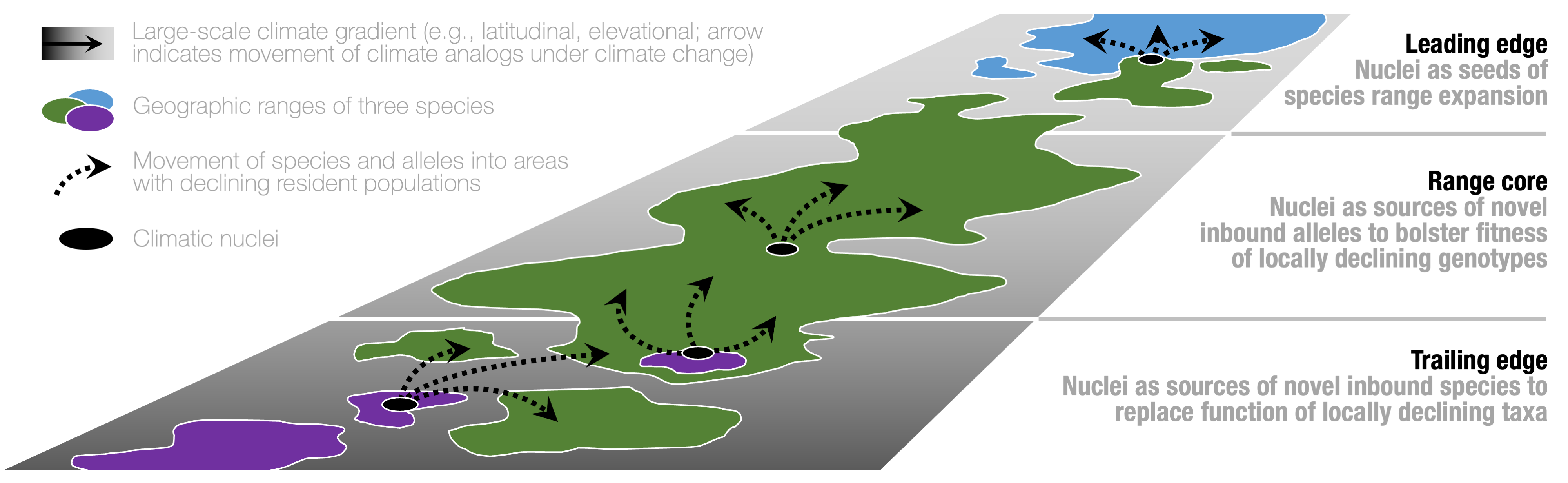
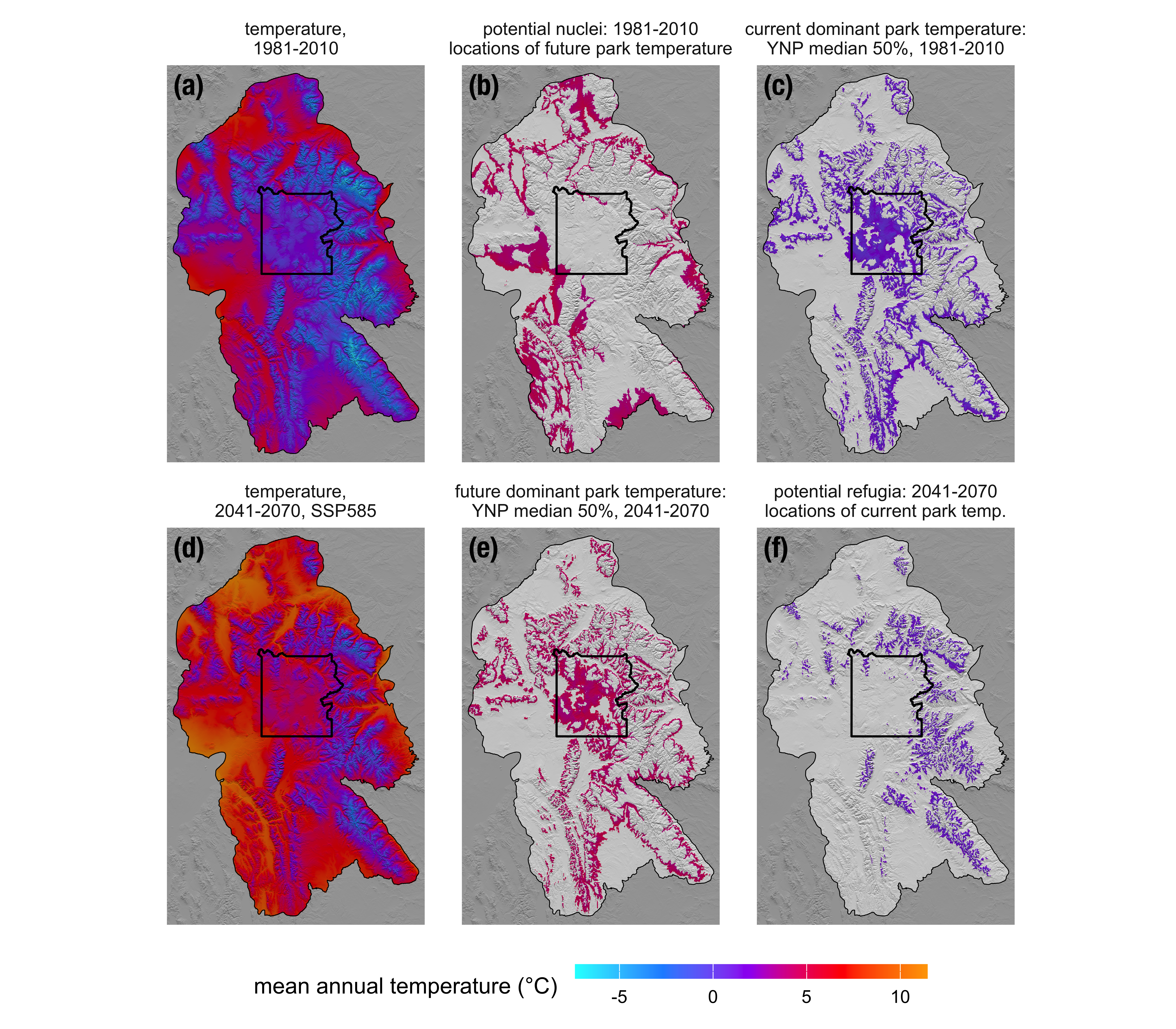
In this GCB paper led by Blair McLaughlin, we introduce the concept of “climatic nuclei.” The counterpart to widely-appreciated climatic refugia, climatic nuclei are the hot/dry sites currently harboring biodiversity that will expand to domintate the surrounding landscape as climate warms. In the paper, we argue that conservation and maagement of nuclei may be critical for helping maintain diversity and function as climate warms, and we illustrate the concept spatially through an analysis of potential nuclei in the Greater Yellowstone Ecosystem (see the figure below). This study was a fun one to be a part of.
Abstract
Conservation of climatic refugia, or locations that will buffer vulnerable species from the effects of climate change, has recently emerged as a prominent climate adaptation strategy. Here, we introduce an important and complementary concept, ‘climatic nuclei’ — locations that harbor populations of species that are expected to expand under future conditions—which has so far received little attention. While the climatic refugia concept focuses on threatened species, the climatic nuclei concept focuses on species that are projected to expand with climate change to help create the functional, diverse, and locally unique ecosystems of the future. We evaluate where climatic nuclei are expected to occur; draw on lessons from the paleoecological and modern ecological literature to better understand how climatic nuclei could function; explore the concept’s application to land stewardship and conservation; and provide suggestions for future research.
Citation: McLaughlin, B., M. Kling, S. Jackson, E. Zavaleta, and D. Ackerly. (2025) Sustaining species of the future: “climatic nuclei” for climate change adaptation. Global Change Biology, 31:e70253 [web, pdf]